
On the occasion of Epiphany, I wanted to share a recipe that differs slightly from the one we know today, and that you may not be familiar with (I must admit that, until recently, I wasn’t either): Almond Pithiviers. It is a traditional French recipe, somewhat old-fashioned in spirit, which I discovered in my grandmother Léonce’s cookbook. According to my mother, this book was given to her as a wedding gift. It dates back to the 1950s and is filled with French recipes that may feel a little dated today, yet remain deeply correct, thoughtful, and absolutely delicious.
We are all familiar with the contemporary galette des Rois, the one commonly found in Paris, made with frangipane, a mixture of almond cream and pastry cream, enclosed between two layers of puff pastry. The Pithiviers differs in one essential way: its filling is a pure almond cream, without pastry cream, offering a much more direct and intense almond flavor.
I was genuinely surprised by this recipe, and I believe I may even prefer it to the modern galette des Rois. I often find pastry cream a little heavy; for other desserts, such as fraisier or strawberry tart, I always prefer a diplomat cream, lighter and more balanced. Here, the almond cream on its own brings a depth and clarity of flavor that I find particularly elegant.
This recipe is also an invitation to learn one of the fundamental bases of French pastry: puff pastry. It forms the foundation of many classic French desserts. The technique itself is not complicated, but it does require an understanding of the process, and respect for a few essential principles: cold, rest, and proportion. If you follow this recipe carefully (especially the resting times between each set of turns, and the quantities indicated) you should have no difficulty making a beautiful puff pastry at home.
Because of these resting periods, this is an ideal recipe to make in winter. When temperatures are close to freezing, the dough can even rest outdoors (as my grandmother used to do, and as my mother still does) where it is often cooler than in the refrigerator. It is a perfect recipe for a quiet Sunday afternoon, when time feels a little more generous. I wish you a very lovely tasting.
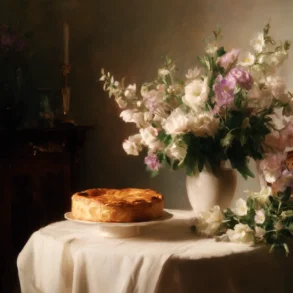
Almond Pithiviers, Prepared According to the Traditional French Method
Ingredients
Puff Pastry
- 2 cups (250 g) all-purpose flour
- 7–7½ oz (195–210 g) unsalted, good quality butter French-style butter preferred, at least 82% fat; not “spreadable” butter
- 1 tsp (5 g) fine salt
- ½ to a generous ⅔ cup (140–170 ml) cold water
Almond Cream
- 1 cup (100 g) finely ground almonds (almond flour)
- 7 tbsp (90 g) granulated sugar
- 3 tbsp (40 g) unsalted butter, very soft
- 2 egg yolks
- 1 pinch fine salt
- 1 tbsp dark rum
For Finishing
- 1 whole egg, beaten
- Powdered sugar, for sprinkling
- 1 fève or small trinket (optional)
Instructions
1. Make the Dough (Détrempe)
- Place the flour on your work surface and make a well in the center. Add the salt.
- Pour in about a generous ½ cup (140 ml) cold water to start and mix quickly with your fingertips. Add a little more water only if needed, never all at once. The dough should be: soft and supple, slightly sticky at first, not elastic, matte, never shiny. Do not knead. Simply bring the dough together into a ball.
- Weigh the dough immediately, before chilling. Prepare butter equal to about half the weight of the dough. Example: if the dough weighs 400 g, prepare 200 g butter.
- Wrap the dough tightly and chill for 20 minutes (refrigerator or outdoors if the temperature is close to freezing).
2. Prepare the Butter
- Place the measured butter between two sheets of parchment paper. Gently tap it with a rolling pin to form a neat rectangle, about ½ inch (1 cm) thick. The butter should be: cold but flexible, firm, not brittle, the same consistency as the dough.
3. Enclose the Butter
- Lightly flatten the rested dough into a square. Place the butter in the center.
- Fold the four sides of the dough over the butter, enclosing it completely. Seal the seams gently with your fingertips.
- Turn the package over so the seams are underneath.
4. Rolling and Folding (6 Turns)
- How to “give a turn” (donner un tour):When the butter is enclosed and the dough is cold, lightly flour the work surface. Roll the dough into a long, straight strip, keeping the sides as even as possible. Press very lightly with the rolling pin and flour as little as possible.When the dough forms a long strip, fold it into three: fold one end over the middle, then fold the other end over the first fold, creating three layers.This is one turn.
- After each turn, rotate the dough 90 degrees (a quarter turn) on the work surface so that you roll in the opposite direction. Always rotate in the same direction (left or right, but be consistent).
- Roll again into a long strip and fold into three to give the second turn. Rotate the dough 90 degrees (a quarter turn). Wrap and chill for 20 minutes.
- Repeat: 2 more turns, then chill 20 minutes, 2 final turns, then chill at least 30 minutes.
- In total, the dough rests three times: after the first two turns, after the next two, and after the final two.
5. Make the Almond Cream
- Mix the ground almonds, sugar, and salt. Add the egg yolks, then the soft butter. Work with a spatula until smooth and thick. Stir in the rum last. The cream should be dense and spreadable, not runny.
6. Assemble the Pithiviers
- Roll the puff pastry to ⅛ inch (3–4 mm) thickness.
- Cut two circles: one for the base, one for the top (slightly thicker).
- Place the bottom circle on a parchment-lined baking sheet. Spread the almond cream in the center, leaving a 1¼-inch (3 cm) border.
- Hide the fève near the edge of the filling. Lightly brush the border with water. Place the top circle over the filling and seal the edges with your fingers.
- Brush with egg wash. Score a simple decorative pattern on top.
- Using the tip of a knife or skewer, pierce the pastry in 5 or 6 places all the way down to the baking sheet to allow steam to escape.
7. Bake
- Preheat the oven to 400°F (200°C). Place the pastry on the lowest rack. Bake 25 minutes at 400°F (200°C), then reduce to 350°F (180°C) and bake 10–15 minutes more.
- Five minutes before the end, lightly dust with powdered sugar to glaze.If the top browns too quickly, loosely cover with parchment.
8. Rest Before Serving
- Remove from the oven and let rest 30–45 minutes before cutting. This allows: the puff pastry layers to set, the filling to stabilize, the flavors to fully develop.
Notes
Butter should equal about half the weight of the dough once mixed.


Delicious! Tastes exactly like the Galette des Rois of my childhood in Paris. I used store bought puff pastry dough and started at the almond crème step. Turned out great!
Thank you so much, Jill. I’m so happy it brought back memories of your childhood in Paris, and that it turned out so well. And next time, you could always try my puff pastry recipe: I promise it’s not as complicated as it seems, it’s really just a matter of getting the feel for it :).