LETTRE DE New York
New York, 15 August 2026
My dear reader,
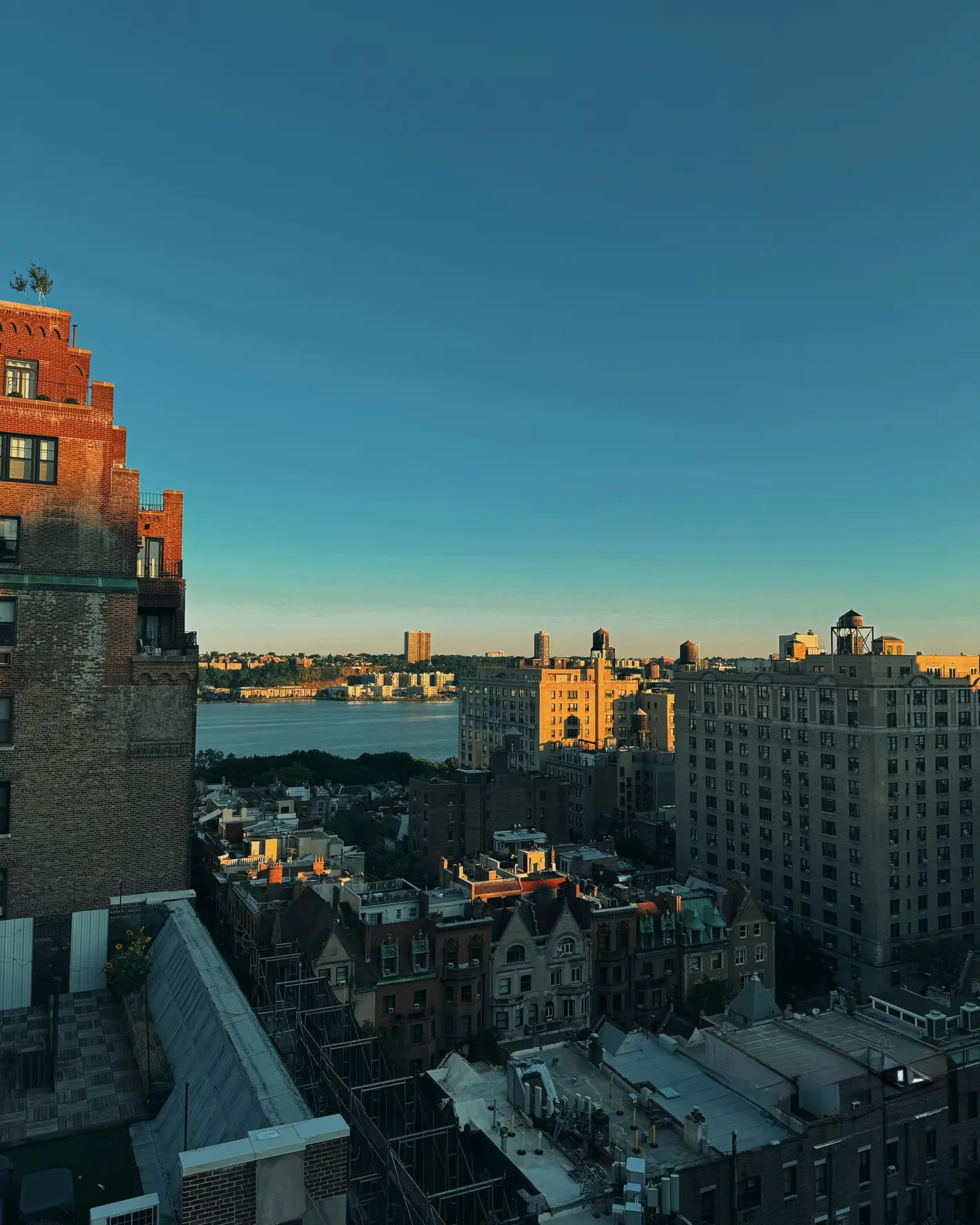
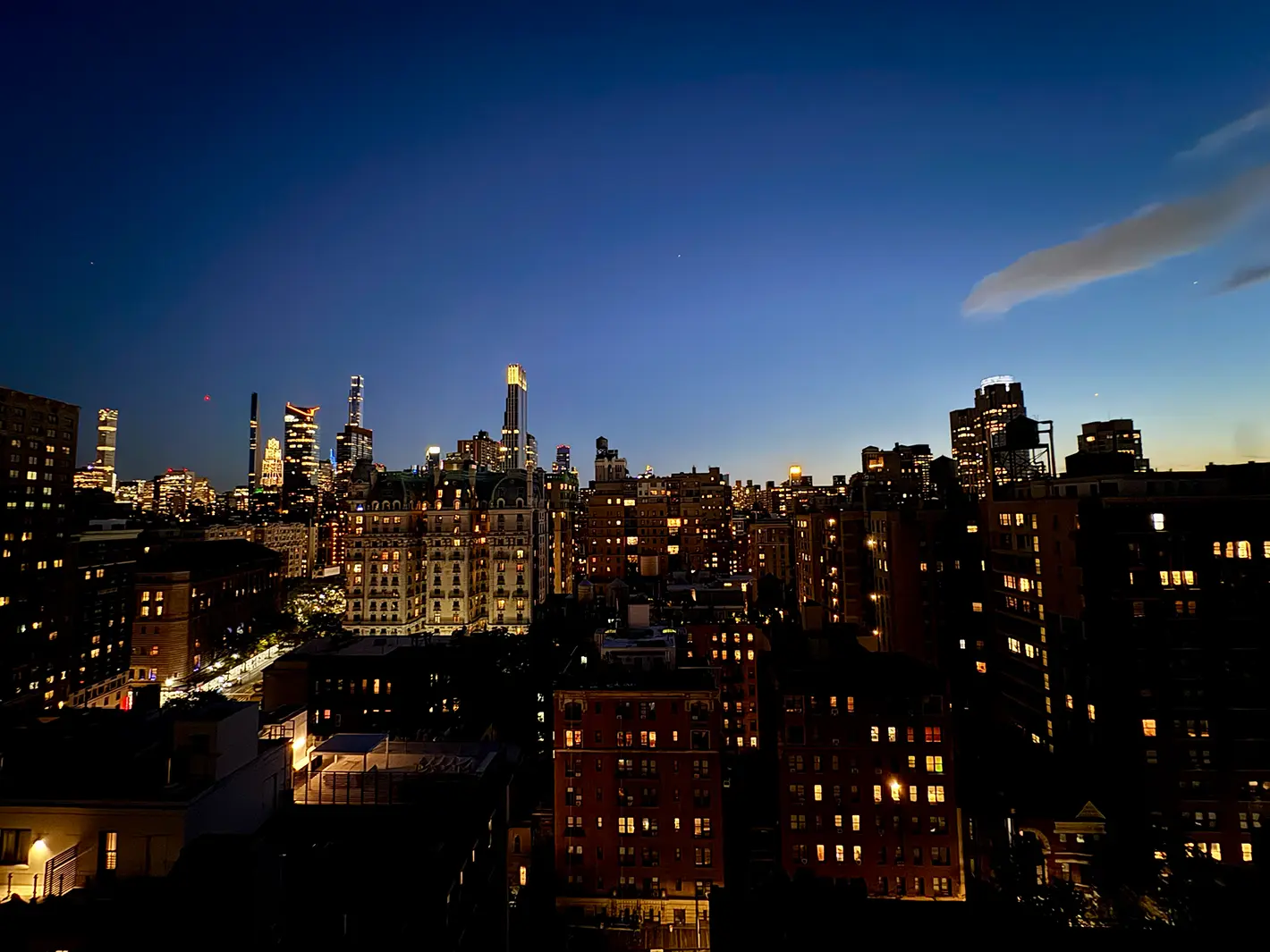
I’m writing to you today from the rooftop terrace of The Wallace, on West 76th Street, above the Upper West Side. I wanted a little height from which to write this letter from New York and, if there is one thing this city does not lack, it is verticality. It is a funny thing, for a girl from the French Alps. I grew up used to looking at mountains from below. Here, one almost has to learn to do the opposite.
This morning, the sky is perfectly blue. The sun catches the glass façades until, for a moment, they become enormous mirrors suspended in the sky. Around me, despite the apparent calm of the city, I can already hear the steady hum of air conditioners in the windows and on the rooftops. The air is heavy and humid, and I am alone up here. I watch New York wake.
There are moments one wishes one could preserve in some way other than a photograph. This is one of them. So I simply try to look for long enough that something of it might remain.
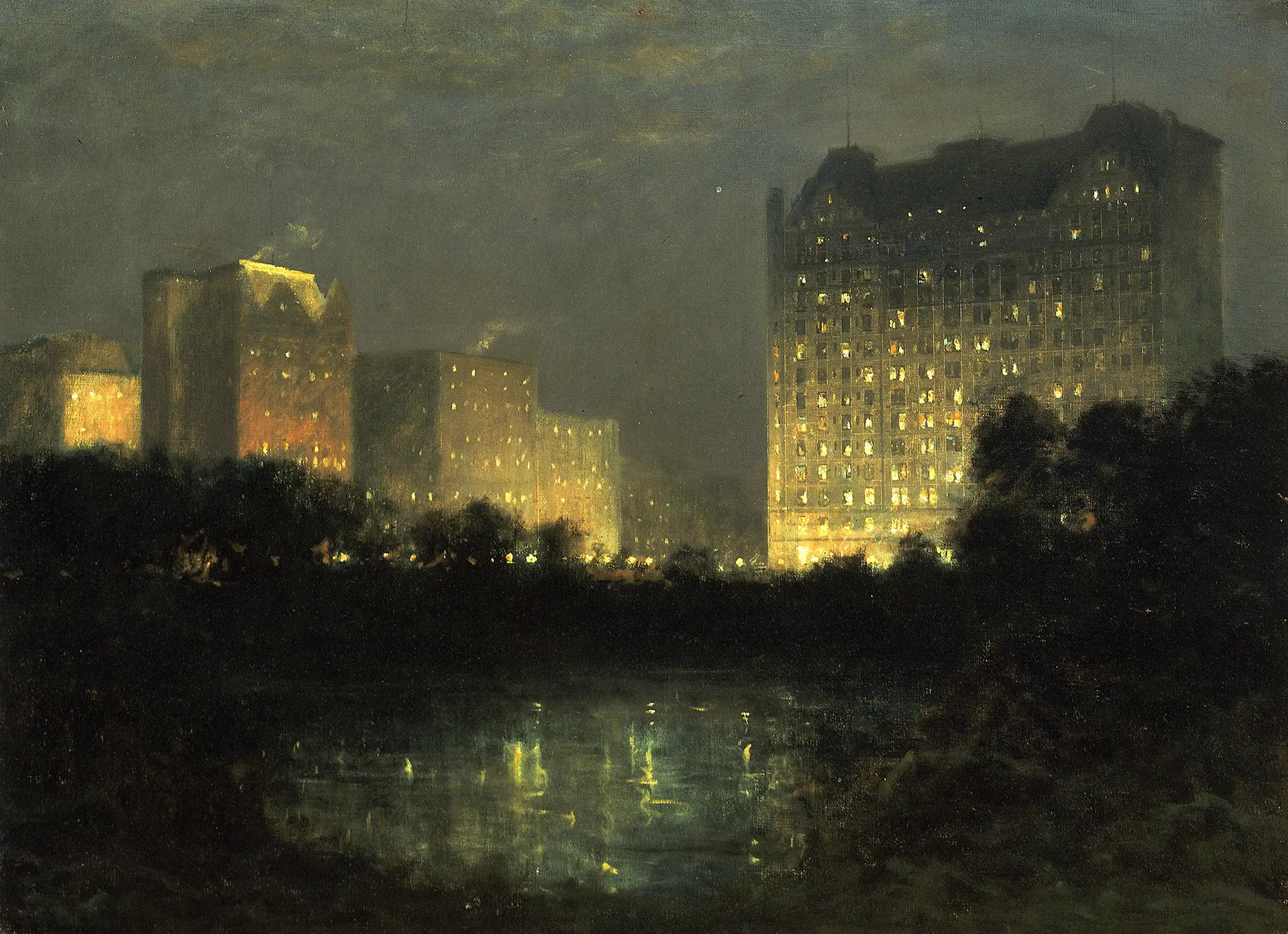
New York has a strange kind of beauty. It is not always immediately lovable, nor particularly delicate. It is rarely postcard beauty. It is rawer than that, almost accidental at times, shaped by generations building one after another without necessarily knowing what landscape they would eventually compose. And yet, from certain windows, the city becomes a painting. Buildings disappear into the clouds, then, a few hours later, their windows light up one by one and their façades become beacons in the night.
And once you come back down to street level, one thing becomes quickly apparent: New York keeps making you look up. You spend your days lifting your eyes. After a while, I found myself wondering how one could live among buildings constructed as though touching the sky were no longer quite a problem of physics without beginning, somehow, to dream a little bigger too. As though no height were entirely forbidden.
Perhaps this is also what New York is: a city that gives you, however briefly, permission to believe that what you build might become important. To look beyond what you have already made. To allow yourself more scale, more freedom, more imagination, more beauty. Here, certain ambitions suddenly seem less absurd.
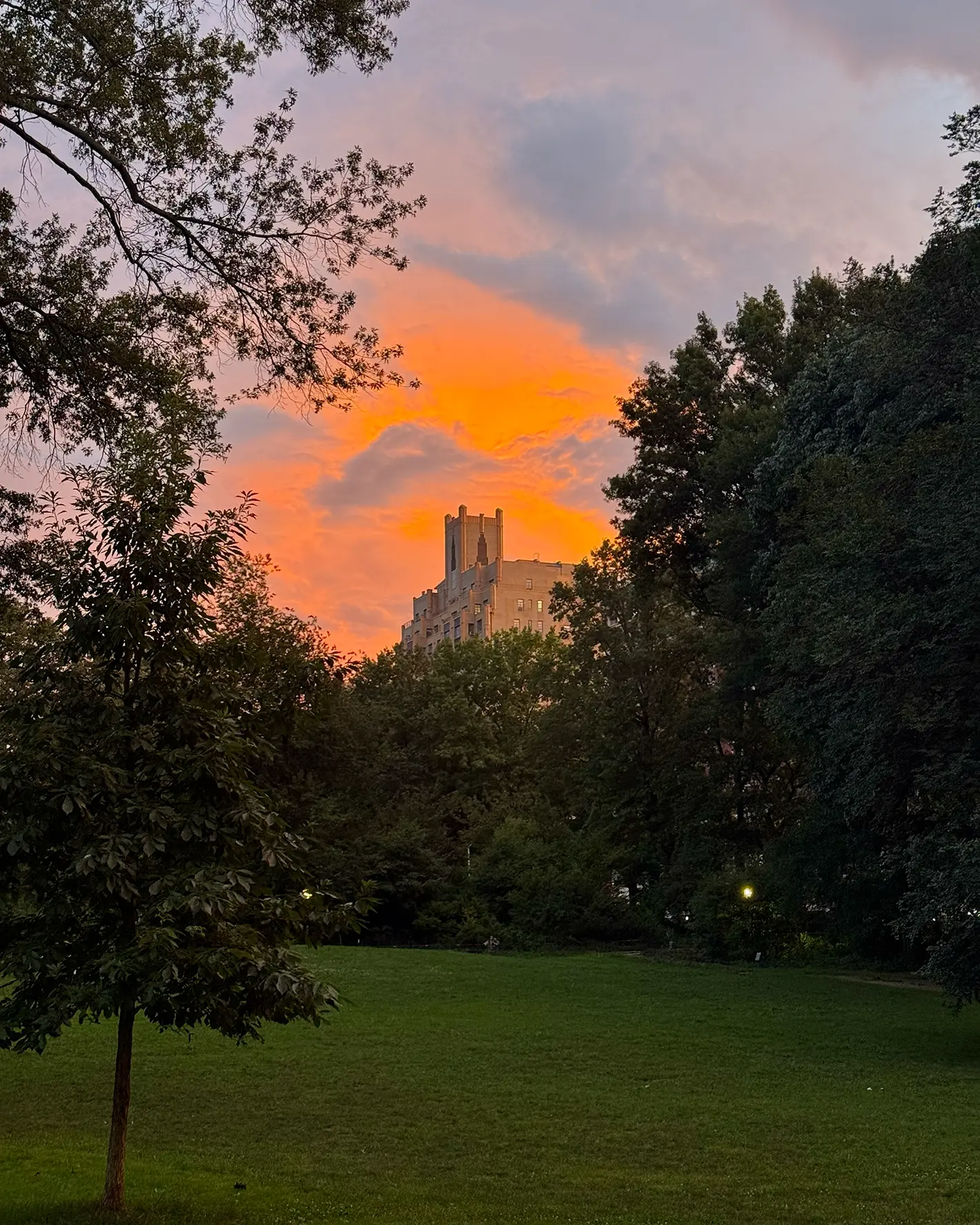
And yet New York is also remarkably good at bringing you back down to earth. For that, you need only step into Central Park. Within a few minutes, the noise begins to recede. When the heat is strong enough, you can even hear cicadas. In places, the trees make the buildings disappear altogether and, beneath your feet, great slabs of grey rock rise through the paths and lawns. Manhattan schist. Rock hundreds of millions of years old.
Above, an entire city seems intent on conquering the sky. Beneath our feet, something was here long before us. I find the thought dizzying. Nature has this peculiar way of returning things to their proper scale in a city where the sky can sometimes feel like the only unit of measure.
On certain evenings, when the heat finally begins to lift, you need only stay a little longer on a bench to see tiny flashes of yellow or green appear among the trees in the fading light. Fireflies. Even in the middle of an island of concrete and steel, something still flickers.
From Central Park, it takes only a few avenues to reach the Metropolitan Museum. And there, instead of hundreds of millions of years written into rock, you are suddenly looking at thousands of years of human life. One evening, I wandered through the museum almost until closing, moving from ancient Egypt to Greece and Rome, then on to the Middle Ages. In front of me were objects made five hundred, one thousand, two thousand, sometimes four thousand years ago.
The men and women who made them are long gone. Some of the civilisations they belonged to are gone too. And yet the objects remain, precious enough that, thousands of years later, we build enormous buildings and perfectly climate-controlled rooms around them.
I found myself wondering what someone might be looking at behind glass five hundred years from now. What will remain of us? Which objects will tell the story of our time?
I did not have very long to come up with an answer. The wooden floor upstairs at the Met began to creak beneath my feet. Lost in thought, I caught myself pressing down a little harder as I walked, simply to hear it creak again, as though that very ordinary sound might remind me that I was still here. The wood smelled of wax, perhaps a little of honey and resin. Or perhaps I imagined it.
A few days later, another Met was waiting for me at the northern edge of Manhattan: The Cloisters.
It is difficult to describe the place without using the word “world.” Because The Cloisters is not simply a museum. It is almost a world invented out of fragments: elements from several medieval cloisters, stones, arches, capitals, stained glass, tapestries, brought together centuries later inside a twentieth-century building. The result should almost be impossible. And yet it holds. The different periods, the different origins, the different hands. A single eye seems enough to hold them together.
In the corridors, knights, saints, fantastical creatures and mythical animals watch you from stone and tapestry. The unicorn appears among the leaves of a world several centuries old and still carries, somewhere within its story, the power to purify water simply by touching it. There is magic here too.
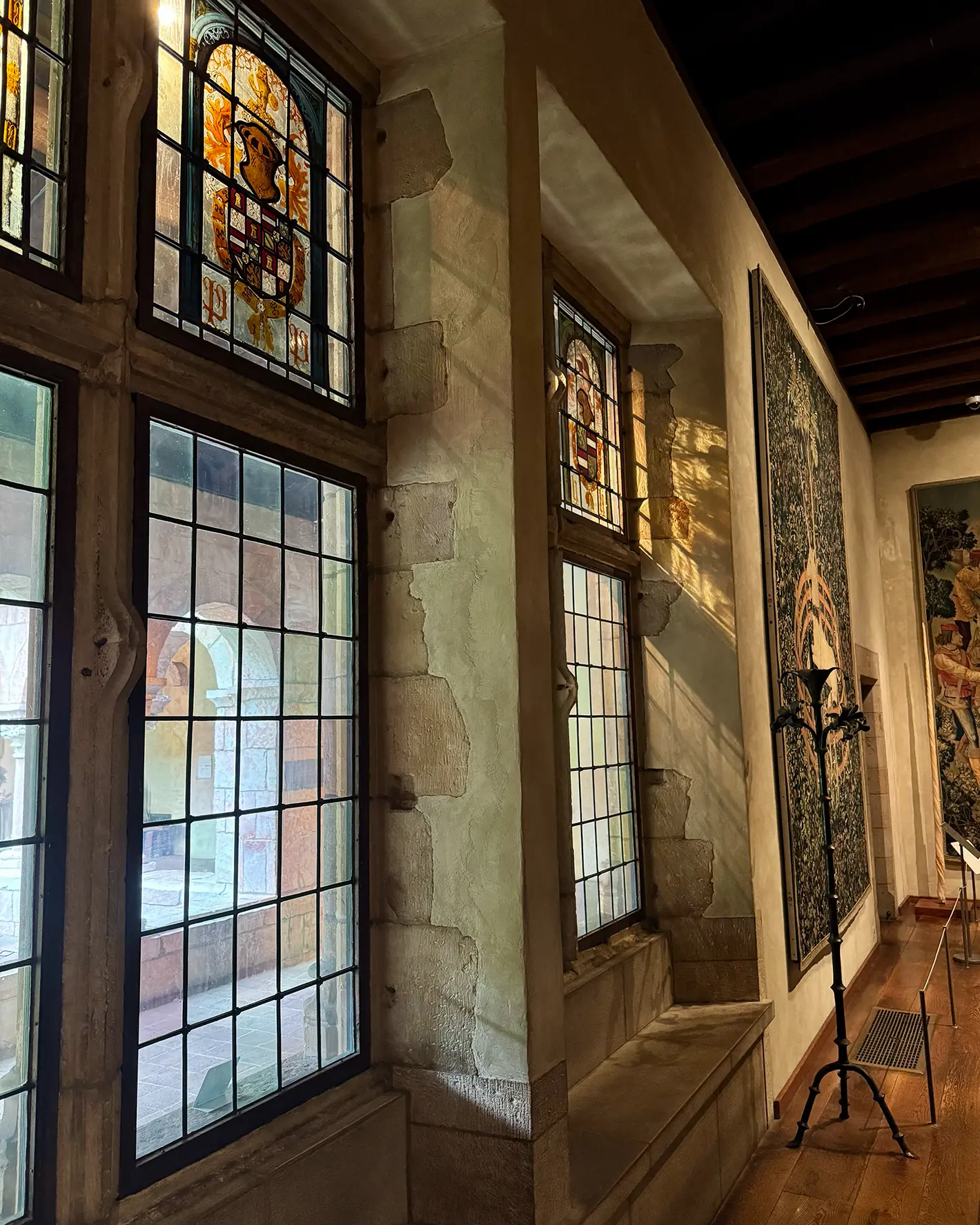
But what struck me most was not only the extraordinary skill behind some of the works. It was the trace of their making. The trace of the hand. An irregularity in the stone. A barely perceptible variation in a pattern. A correction. An accumulation. Several artisans sometimes working on the same object, sometimes over many years.
Living among perfectly smooth images, it is easy to forget that many extraordinary things were made this way. Slowly. Imperfectly. Fragment by fragment.
The Cloisters reminded me that worlds may not be built in one grand gesture. They are built through accumulation. And that sophistication does not necessarily come from perfection. It can also come from a certain freedom: the freedom to make things that do not need to be perfectly useful, profitable, or even particularly important in order to deserve to exist.
Perhaps very different things can belong beside one another when the eye that connects them is strong enough. Perhaps making something alive requires less perfection than I once thought.
I thought a great deal about time during this trip. Probably because New York seems to have such a strange relationship with it. Everything moves quickly here. People walk quickly, speak quickly, eat quickly, build quickly. Something always seems urgent.
And yet all you have to do is look around to be constantly reminded of what came before us: the rocks in Central Park, the antiquities at the Met, the medieval stones of The Cloisters. Then all you have to do is look up once more.
Some of the stars we see sent their light towards us hundreds or thousands of years before we were here to receive it. Some may already be different now. Some may no longer exist in the form in which we see them. And still, their light continues on its way.
I found that strangely comforting.
One evening, sitting once again on a bench in Central Park, I watched people passing in front of me. Some were hurrying towards appointments that seemed absolutely crucial. Others were arguing into their phones, gesturing as they spoke. Many were staring at their screens with the intense concentration we give to things that, in the moment, seem to carry enormous importance.
And suddenly I felt an almost physical sense of relief. On the scale of all this, almost nothing that preoccupies us is truly important. We are here for an extraordinarily short time. There would be something frightening about that thought if it were not, at the same time, so liberating.
Because if we do not know what will remain, perhaps we do not need to know. None of the artisans whose work I saw at The Cloisters could have imagined that, eight hundred years later, a woman sitting in Amsterdam would be writing about them after seeing their work in New York.
They simply made things. Some disappeared. Others made their way to us. And no one could have known which would be which.
Perhaps that is why New York made me want, at the same time, to take what I am building much more seriously and to take myself much less seriously. To want more for the things I make, without needing to know exactly how far they will go. To work with ambition, but perhaps with a little less fear. To make some things simply because, to my eyes, they deserve to exist.
Because in the end, we have only a ridiculously brief amount of time in which to make a few fragments of a world. They will not all be perfect. They certainly will not all remain. But perhaps that is not the point.
From my bench that evening, Manhattan continued to rise behind the trees as though none of it could ever disappear. And somewhere in the grass, a firefly lit up and went dark.
Barely a second.
It seemed enough.
Léonce.
PS. If this letter has made you want to return to New York, or perhaps discover it for the first time, you can find my favorite New York addresses in Le Carnet d’Adresses.