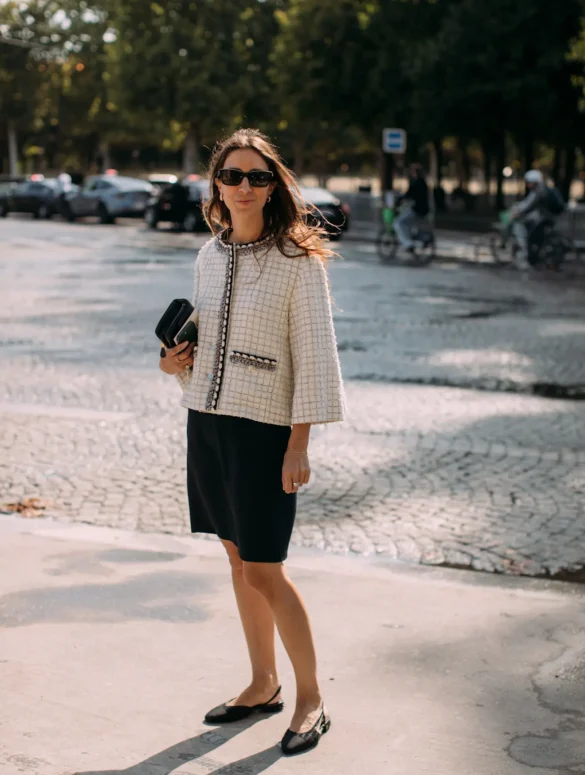
A few months ago, one of you wrote to me with these words: “Hi! I’m in my early thirties and would love to revamp my wardrobe into something more chic, but affordably. What pieces are worth investing in, and where should I save?”
It’s a question I promised to answer. And I wanted to do so sincerely, by sharing not only my advice and small strategies, but also the lessons I have learned myself. For it has now been seven years that I’ve been writing about fashion, analyzing it, pulling it apart, seeking to understand its subtleties. And in that time, I have had to rebuild my own wardrobe from scratch more than once, sometimes with clarity, at other times with hesitation.
Lost in Style
For many years, I felt adrift in questions of style. At the beginning of my corporate career, I dressed in a way that was perhaps a touch too feminine, a little too sensual for the office, believing, somewhat naïvely, that my clothes would have little influence on my future. Later, when I entered the tech industry (a world that was overwhelmingly masculine), I swung to the other extreme: oversized silhouettes, austere cuts, almost a uniform that seemed to erase me, ensuring that no curve or trace of skin could be seen. At the time, I thought concealing my appearance would lend me seriousness, competence.
For a long while, I believed that caring too much about one’s style was to risk being judged frivolous, that fashion might somehow detract from intelligence. I imagined that dressing with studied indifference would allow me to be taken more seriously. With time, I came to understand that it is not so simple, and that there is, in fact, a delicate balance to be found.
Today, that balance feels harder than ever. Social media has blurred the lines: it is easy to imitate the look of another rather than cultivate one’s own. And then there is what I call the influencer look: outfits striking online, yet exaggerated in ways that make them less wearable in daily life. At times, it borrows from corporate codes, tailoring and polish styled more for show than for the office itself.
The Weight of Appearance
Some will say that appearance has no real importance, that it is superficial, even absurd. But I believe they are mistaken. A first impression is formed in seconds, sometimes in a tenth of a second, sometimes in seven, and while those judgments may evolve, they are there nonetheless. To be well-dressed, to feel aligned with one’s clothing, can provide that subtle yet vital sense of assurance, in professional encounters, in the most personal of moments, and in the quiet relationship one has with oneself.
If you’ve been reading Léonce Chenal for a while, I imagine I am preaching to the converted. But if you remain unsure, try this: walk into the same shop twice, once elegantly dressed, once casual, and observe how the experience shifts. You will notice it immediately: in the service, in the glances, in the unspoken. One may regret that the world functions this way, but that does not make it less true.
I suspect this instinct to judge by appearance is deeply primal, bound up with survival. The important thing is to recognize it, scientia potentia est, knowledge is power, and to know how to turn it, gently, to our advantage.
A Structured Approach
In another life, I spent years as a data analyst in Paris and London. From that time I have kept a taste for order, the desire to bring structure to what seems intangible, to trace patterns in what appears instinct alone. This is the spirit in which I wanted to respond: how, in one’s early thirties, can one reimagine a wardrobe to feel more chic, while remaining thoughtful about budget?
Observe Before You Buy
Before purchasing anything new, I suggest beginning with a simple exercise: for two or three weeks, without altering your habits, note down each day what you wear.
Two truths will quickly become apparent:
- You likely wear only 10 to 20 percent of what you own.
- You already have a uniform, whether you’ve named it or not.
A uniform is the combination you reach for instinctively, without calculation. Mine is a pair of jeans and a white t-shirt, or a shirt tucked neatly into jeans with a belt. Season after season, it remains what feels most like me. Once you’ve identified your uniform, compare it to the reality of your wardrobe. The gap is often striking.
We rarely shop for the selves we are. More often, we shop for the selves we imagine becoming. A dress meant to transform our style but never worn, a cardigan too exuberant for everyday life, heels that remain untouched in their box. Little by little, the wardrobe overflows, yet every morning the same phrase returns: “I have nothing to wear.”
My 80/20 Rule
A year ago, I recognized this in my own closet: 80 percent of what I owned were statement pieces, elegant, but seldom worn, while just 20 percent were true basics, the essentials I wore daily.
So I reversed the balance.
- 80 percent basics: my jeans, shirts, t-shirts. The building blocks of my daily uniform. I spend less here, but I never compromise on quality fabrics: cotton, linen, wool, sometimes cashmere.
- 20 percent statement pieces: coats, blazers, handbags, shoes, jewelry. Here I invest. I buy sparingly, but I buy to last.
Statement pieces hold their own kind of alchemy: they elevate the simplest uniform in an instant. Jeans and a t-shirt become effortless chic with the addition of a well-cut tweed jacket, a pair of loafers, a structured bag. Knitwear (cardigans, sweaters, turtlenecks) hovers between the two. Some belong with the basics, others rise to the level of statement pieces, depending on their fabric, cut, or refinement.
A New Way of Consuming
Since adopting this method, my relationship with shopping has shifted. I no longer buy impulsively. My spending has softened, but I have never felt deprived. I have learned to renew my basics regularly, to choose them with care. And I have rediscovered my statement pieces, once neglected, now seamlessly woven into my daily looks.
Most of all, I feel at ease in every circumstance. At home, in jeans and a t-shirt, I am comfortable. When I step outside, I add a blazer, a pair of loafers or sneakers, a beautiful bag, and I feel instantly elegant. It is the best of both worlds.
This article includes select links supported by Vestiaire Collective. It is not a sponsored article; the writing and choices remain entirely my own, guided only by independence, curiosity, and discernment. Some links may also be affiliate, which means I could earn a small commission if you choose to purchase, always at no cost to you.
Reimagining Your Wardrobe
At this stage, perhaps the logic of my method feels clear, yet you may be wishing for something more concrete. What exactly is in my wardrobe? And, to return to the original question: which pieces are worth investing in, and where can one save?
The Essentials
For me, it begins with simple white t-shirts: short- or long-sleeved, always in 100% cotton. I often choose them from Mango or Massimo Dutti, perfect on their own or layered under a jacket or knit. Then there are shirts: I lean more toward light blue than crisp white, which can sometimes feel a little too formal under a black blazer. Affordable versions can be found at J.Crew or Massimo Dutti, while for something more elevated, I love the designs of Marie Marot.
No wardrobe of mine would be complete without jeans. I keep them in several washes; lighter for spring and summer, darker for autumn and winter, and in cuts that feel modern yet wearable: straight-leg and wide-leg styles are my current preferences. Finally, fine knits are indispensable. I like light sweaters from Sézane, especially the Jacob jumper, and simple crew-necks from Massimo Dutti. For more luxurious options, I turn to cashmere, and sometimes even to the men’s section at Sandro.
Statement Pieces
When it comes to statement pieces, I prefer to buy sparingly, but better. A blazer is essential: in wool for autumn and winter, or in lighter fabrics for spring. Last year, I bought a beautiful version from Balzac Paris which I’ve already begun wearing again this fall. Sandro remains a favorite as well, I invested in this navy blazer years ago, and it has been a faithful companion ever since.
For mid-season, I rely on a quilted Barbour jacket or a classic overcoat that can slip over anything. A trench coat also has its place, though I wear them less than I once did, I recommend a shorter cut for a more modern silhouette, such as Sézane’s Bobby jacket. I also like to have a short jacket on hand, something chic in white tweed, or in autumnal checks or houndstooth. And of course, a wool coat, long or short depending on preference, is indispensable for winter.
Shoes & Bags
I have always favored shoes that allow me to walk with ease. In my wardrobe, you’ll find ballet flats (such as The Fonteyn in cedar suede by Margaux), a clean pair of sneakers (I particularly like Nike’s Cortez), classic loafers (Tod’s remain unmatched), and short block-heeled boots, never higher than five centimeters.
Accessories are what bring everything together. A leather belt (mine from Sandro is worn constantly with a tucked-in shirt and jeans) always feels more polished. A timeless handbag is, to me, essential. A few years ago, I invested in a vintage Céline with the old carriage clasp on Vestiaire Collective similar to this one (always ask for the physical authentication for peace of mind), but in black leather with a red lining, a piece I adore and carry constantly. (My bag is often mistaken for Hermès, perhaps because of the carriage motif.) Vintage Céline has become my quiet obsession; I still dream of adding another, perhaps this one in burgundy leather or even this beautiful one in an exotic skin. And finally, there is always a tote bag (I own several) for my essentials, especially when I travel with my laptop.
To Continue
For those who wish to go deeper, I’ve gathered the precise pieces I would select if I were to begin again, shared quietly in Edit No.9: The French Autumn Wardrobe, If I Were to Begin Again.