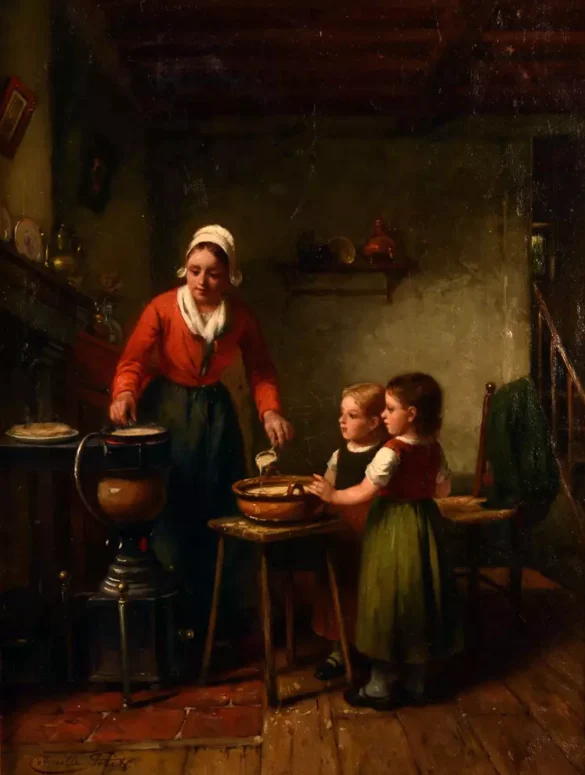
Today is February 2nd, and as every year in France, we celebrate La Chandeleur. An old, deeply rooted tradition, and, as so often in France, one that is inseparable from a simple pleasure: gathering around something delicious. La Chandeleur is, above all, the day of crêpes.
The word Chandeleur comes from fête des chandelles, an ancient pagan celebration inherited from Roman times, during which people walked through the streets carrying torches and candles in honour of the god Pan. In the fifth century, the celebration was Christianised by Pope Gelasius I and came to mark the presentation of Jesus at the temple, forty days after his birth.
Round and golden, crêpes have long symbolised the sun, the return of light, and the end of winter. They were also offerings, surrounded by beliefs and small superstitions. An old custom held that the first crêpe should be tossed several times in the pan to ward off bad luck for the year to come. In rural traditions, it was even said that one should flip it with the right hand while holding a coin in the left, to attract prosperity and good fortune.
To honour this tradition, and to celebrate La Chandeleur in my own way, I returned to my grandmother’s cookbook from the 1950s. Within its pages, I rediscovered an entire grammar of crêpes: the classic batter, the finer version, crêpes Suzette, crêpes Georgette, and regional variations. A small collection of recipes you can easily make at home, and that delight both children and adults alike. Here they are.
Classic French Crêpe Batter
(makes about 12 crêpes)
- 1 cup (125 g) all-purpose flour
- 2 tablespoons (25 g) vanilla sugar
- 2 tablespoons (30 g) unsalted butter, melted
- 1 pinch of fine salt
- 2 large eggs
- 1 cup + 1 tablespoon (25 cl or 250 ml) cold milk (plus 1–2 tablespoons more if needed)
- 1 tablespoon rum or cognac (optional)
In a mixing bowl, add the sifted flour. Make a well in the centre and add the eggs, salt, vanilla sugar, and cold milk. Whisk until the batter is very smooth and pale. Adjust with a little more cold milk if necessary: the batter should lightly coat the whisk and fall back in a ribbon. Add the melted butter and whisk to combine. If any lumps remain, strain the batter before adding the butter. Prepare the batter 2 to 3 hours in advance and let it rest at room temperature.
Cooking
Lightly butter a pan and heat it until very hot. Pour in a very thin layer of batter, tilting the pan to spread it evenly. When the crêpe is set on one side, flip it quickly and cook briefly on the other side. The pan should be kept over fairly high heat to ensure thin, tender crêpes without drying them out. Once cooked, dust the crêpes with vanilla sugar, fold them in half, and arrange them on a warm serving plate.
Note
Do not add more sugar to the batter: sugar causes crêpes to brown too quickly in the pan. As crêpes are always served dusted with sugar or spread with jam, they will be sweet enough as they are.
Fine French Crêpe Batter
(for very thin, delicate crêpes)
- 2 cups (250 g) all-purpose flour
- 2 large eggs
- 3 egg yolks
- 2 egg whites, beaten until stiff peaks form
- 3 tablespoons + 1 teaspoon (40 g) sugar
- ½ teaspoon fine salt
- 4 tablespoons + 1 teaspoon (60 g) unsalted, melted butter
- 2 cups cold milk, plus 2 tablespoons (500 ml) if needed
- 1 to 2 tablespoons rum, cognac, or orange blossom water (optional, to taste)
In a large mixing bowl, add the sifted flour. Make a well in the centre and add the whole eggs and egg yolks, followed by the salt, sugar, and cold milk. Whisk gradually until the batter is very smooth, pale, and lump-free. Add the melted butter and whisk to combine. If necessary, strain the batter to remove any remaining lumps. Stir in the chosen flavouring (rum, cognac, or orange blossom water), according to taste. Let the batter rest 2 to 3 hours at room temperature. Just before cooking, beat the egg whites until stiff, then gently fold them into the batter using a spatula, taking care not to deflate them. Cook the crêpes in the same way as described in the Classic French Crêpe Batter recipe.
Notes & explanations
- Why so many eggs?
The yolks bring richness and colour, while the beaten whites lighten the batter. The result is a crêpe that is thinner, softer, and more delicate in texture. - How is this different from a classic crêpe batter?
This is a more refined, richer preparation, intended for elegant crêpes that are folded and served warm, rather than rustic everyday crêpes. - Why add the egg whites last?
Folding them in at the end preserves their airy structure and gives the crêpes their characteristic lightness. - About flavourings
Use 1 tablespoon for a subtle aroma, 2 tablespoons for a more pronounced flavour. Orange blossom water is more intense: use sparingly.
Variations
Crêpes Suzette
Prepare the crêpes using the classic French crêpe batter. In a bowl, cream 3½ tablespoons (50 g) unsalted butter with ¼ cup + 1 teaspoon (60 g) sugar until smooth and pale. Add the finely grated zest of two oranges, then 2 to 3 tablespoons curaçao or Grand Marnier. Spread a small amount of this mixture over each crêpe, fold them, and return them briefly to the pan. They may be lightly flambéed just before serving.
In this cookbook, crêpes Suzette are flavoured with curaçao, as was common at the time. Today, Grand Marnier is more often used, without altering the spirit of the recipe.
Crêpes Georgette
Pour a very thin layer of crêpe batter into a hot, lightly buttered pan. Immediately place a thin slice of fresh pineapple on top and lightly cover it with a little more batter. Cook the crêpe as usual, allowing the fruit to soften gently. Unlike other crêpes, these are not folded.
Crêpes with Jam
Spread each crêpe with a thin layer of redcurrant jelly or any jam of your choice, then roll them gently like cigars, without tightening, so that the filling does not escape.
Breton Crêpes
Sift 1 cup (125 g) all-purpose flour and 1 cup (125 g) buckwheat flour into a bowl. Add a pinch of fine salt, a generous pinch of cinnamon, then 1 to 2 tablespoons rum. Gradually whisk in 1½ to 2 cups cold milk (about 360–480 ml), until the batter is smooth, supple, and slightly fluid. Use this batter to cook the crêpes. Just before removing them from the pan, drizzle the surface with a little hazelnut-browned butter, lightly sweetened with light brown sugar. Fold each crêpe into quarters and serve hot.